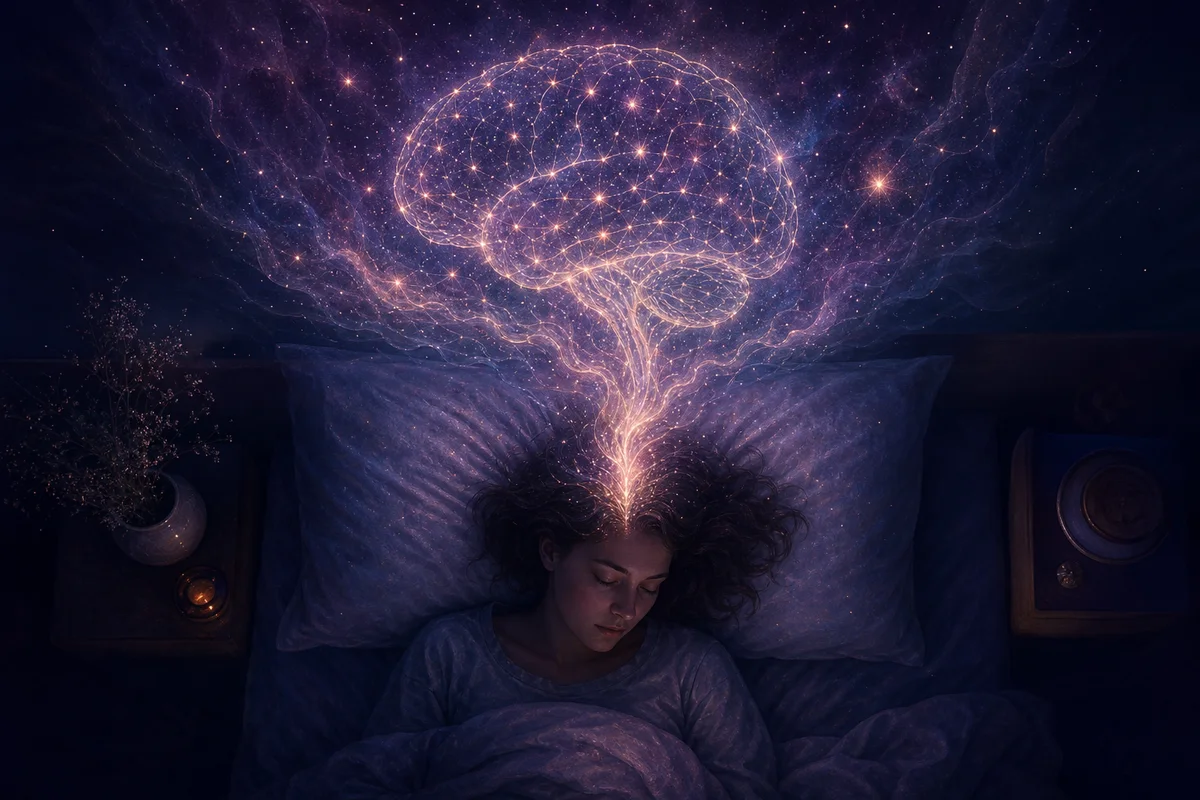

Ideas do not only come from effort at the desk. A growing body of research shows that how we sleep, move and recover shapes how freely we connect ideas. This is why LUMI reads the body, not only the calendar.
| State | What the research found | What it suggests |
|---|---|---|
| Sleep onset (N1) | In a hidden-rule task, people who spent at least 15 seconds in the first stage of sleep found the rule 83% of the time, against 30% for those who stayed awake: close to three times the rate.[12] | A short, light rest can open a creative window |
| A full night | After a night of sleep, 59% of participants discovered a hidden shortcut, compared with 23% after the same time awake.[13] | Sleep on a hard problem before forcing it |
| REM sleep | A nap that included REM sleep improved performance on a remote-association test by almost 40%; quiet rest without REM did not.[14] | Protect full cycles so REM has time to happen |
| Walking | Walking raised creative output on a divergent-thinking task by about 60% compared with sitting, and the boost lingered after people sat back down.[15] | Move when you are stuck |
| Sleep loss | One night without sleep impaired innovative and flexible thinking.[16] After 17 to 19 hours awake, performance on some tests was comparable to a blood alcohol level of 0.05%.[17] | Tiredness quietly costs original thought |
The twilight zone. The drift between waking and sleep, known as N1 or hypnagogia, is a creative sweet spot. The study above borrowed Thomas Edison's trick: nap holding a light object, and wake when it drops. Work from the MIT Media Lab has built a device around the same window to guide what people dream about.[12, 18]
Overnight reorganisation. During sleep the brain replays and restructures recent memories. Deep sleep helps extract the rules behind them, while REM sleep links distant, loosely related ideas, which is one reason a problem can look different in the morning.[19]
Movement as a reset. Stepping away to move breaks fixation on a single approach and gives the mind room to wander, a state linked to creative incubation.[6, 15]
Practical notes from the research
Try a short "Edison nap". Rest with a light object in hand and let it wake you as you drift off, then write down what was on your mind.
Protect 7 to 9 hours. Full sleep cycles give REM and deep sleep the time they need.
Move when you are stuck. A short walk or light exercise lets your mind re-route before you return to the work.
These findings come from laboratory tasks with specific groups of people. We treat them as directions to test in daily life, not as guarantees.