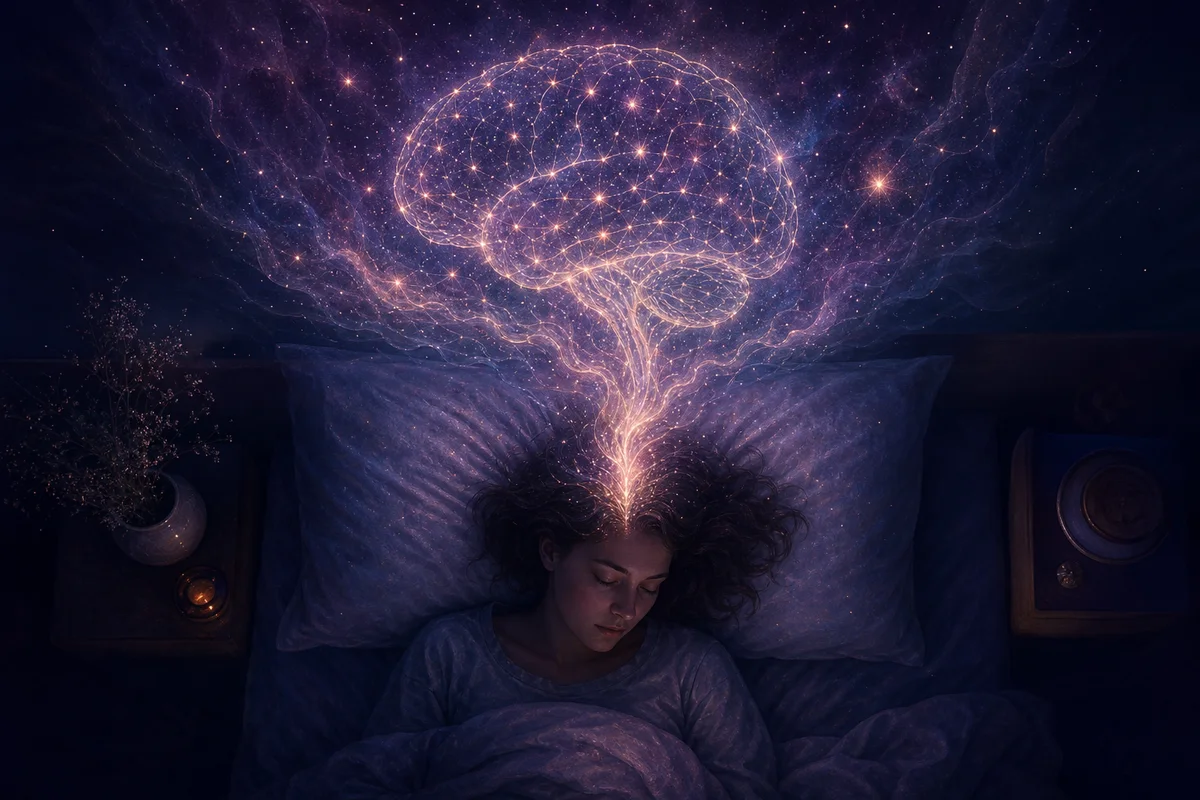

Breaking the usual limits: hyper-association
In REM sleep, with the prefrontal "guard" off duty, a mechanism called hyper-associativity takes over. Signals stop taking the usual main roads and build bridges between distant parts of the brain.
- Why it sparks ideas. It lets two concepts with no causal link collide. By day, some ideas are locked in place by common sense; at night the brain can try combinations it would never allow awake.
Two famous dream stories
- Elias Howe and the sewing machine. Howe struggled for years with where to put the needle's eye, because in everyday logic the eye sits at the tail. As the story goes, he dreamed he was captured and saw spears raised against him, each with a hole near its tip. He woke, moved the eye to the point of the needle, and the lockstitch sewing machine followed.
- Mendeleev and the periodic table. After days of arranging element cards with little sleep, Mendeleev is said to have seen the table in a dream: with his insistence on the existing order relaxed, his mind assembled the pieces into a grid. (Both stories are told by the inventors or their friends; how much the dream itself did is debated.)
- The takeaway. A dream is a legal sandbox for innovation, free from the penalties of logic. It allows the wildest combinations, and sometimes breaks through a dead end you hit during the day.
Set a dream catcher: the golden ten seconds after waking
- Do not reach for your phone. The light and noise of a screen switch the prefrontal cortex on at once and melt the dream away.
- Stay still with your eyes closed. Rewind the fragments in your mind, like replaying a tape.
- Keep paper or a voice note by the bed. As soon as you catch a thread, note the keywords (a red building, chased by a dog, grandmother). Do not worry about grammar or logic.
How to use your dreams
- For inspiration. Go to sleep with a question ("I need to get past the problem in this proposal"). In the morning, read your dream notes and look for the odd combinations: they often offer a completely new angle.
- For stress. If one scene keeps recurring (you cannot find the exam room, you keep falling), your unconscious is raising an alarm. Face that source of stress while awake, and look after yourself.
打破物理维度的限制:联想宽泛化
当你在 REM 睡眠中做梦时,大脑的前额叶皮质“保安”下班了,一种叫做联想宽泛化(Hyper-associativity)的机制全面接管。此时,大脑的神经信号不再走常规的“主干道”,而是随意在极其遥远的脑区之间搭建桥梁。
- 为什么能产生灵感?它允许完全没有因果关系的两个概念发生强行碰撞。清醒时被常识牢牢锁住的想法,在梦里可以尝试白天绝不会允许的排列组合。
两个著名的梦境故事
- 缝纫机发明者埃利亚斯·豪(Elias Howe):他苦思冥想多年都无法解决针眼该放在哪里的问题,因为在清醒逻辑里,“针眼在针尾”是根深蒂固的常识。据他讲述,他梦见自己被土著人抓走,对方举起长矛刺向他,他发现长矛的尖端有一个洞。醒来后他一拍大腿,把针眼移到了针尖,缝纫机就此诞生。
- 元素周期表(门捷列夫):他连续几天几夜心力交瘁地排列元素卡片。据流传的说法,在梦里,前额叶放松了对“必须按现有逻辑排列”的执念,大脑自动用一种更具全局观的网格模式将碎片拼好,他在梦里清晰地看到了那张表。(这两个故事都来自当事人或其友人的回忆,梦境究竟起了多大作用,学界仍有争议。)
- 总结:梦境是一个合法的、免受逻辑惩罚的创新沙盒。它允许大脑做最疯狂的排列组合,往往能一举突破白天的思维死胡同。
设置“捕梦网”:醒来的黄金 10 秒
- 醒来的第一个动作绝对不要是睁眼看手机。手机屏幕的亮光和琐碎信息会瞬间激活前额叶,像强光一样融化梦境。
- 保持闭眼、身体不动的姿势,在脑海里像倒带一样“回放”刚才的梦境碎片。
- 床头常备纸笔或语音备忘录(梦境日记):一旦抓住线索,立刻用关键词记下来(如:红色大楼、被狗追、外婆)。不要在乎语法和逻辑。
如何利用梦?
- 激发灵感:带着问题入睡(睡前对自己说:我需要解决 XX 策划案的瓶颈)。醒来后查看梦境日记,寻找那些看似荒诞的组合,往往能提供颠覆性的新视角。
- 排解压力:如果你发现梦里高频出现某种特定场景(如找不到考场、不停坠落),这代表你的潜意识在疯狂报警。在清醒时正视这个压力源,进行心理调节。